The Missy Woods case raises a difficult question for consequential public service institutions: what does it take to recognize and respond to a serious problem before the consequences become enormous?
On September 8, former Colorado Bureau of Investigation forensic scientist Yvonne “Missy” Woods was sentenced to 10 years in prison after pleading guilty to crimes connected to altering DNA evidence. More than a thousand cases have been identified as affected, including hundreds involving sexual assault.
I've spent more than a decade working in public safety in Colorado, but I have no knowledge of this case beyond what has been made public. I don't know what happened inside that laboratory from day to day, what different people knew at different points, or why one person made the decisions she did.
What I do know is that what happened is absolutely heartbreaking, and for people responsible for equally consequential work, deeply unsettling.
It raises two questions for me:
How can a serious problem persist inside an institution even when there are opportunities to see it, question it, and do something about it?
And what would it take for these institutions to have a better chance of preventing, recognizing, and responding to problems before they become failures with enormous consequences?
Why Problems Persist
The conditions that allow failures like this to accumulate are disturbingly ordinary.
Workloads rise and supervisors get stretched thin. Exceptions that are initially rare become routine. Someone who moves an unusual amount of work may simply look unusually productive, while a concern that could be worse is easy to set aside. At the same time, software systems are diligently recording patterns that go largely unexamined.
None of this necessarily resembles the beginnings of a crisis, which is part of what makes it difficult.
At sentencing, Woods's attorney described her as someone who worked unusually long hours and handled an extraordinary volume of cases. He said she averaged 338 cases a year over her career, but completed 681 in 2016 and 644 in 2017, while maintaining what he described as an exceptional record of evaluations. Woods herself told investigators she did not really know why she had manipulated the data. But the contrast raises a different question: what kinds of information is an organization set up to recognize, reward, and rebuke?
Productivity and turnaround time matter, particularly in public service, where delay itself can cause harm. Metrics are created and monitored for exactly that reason. They also shape how performance is understood and can influence the decisions people make in response.
High output is easy to recognize and applaud. The quality of a judgment, the appropriateness of an exception, the slow deterioration of a process, or the conditions that make poor choices more likely can be much harder to summarize and therefore harder to give equal consideration.
Metrics and other information become useful only when an organization can understand what they mean, how they shape decisions, and what to do with them.
Colorado's Office of the State Auditor made part of this problem concrete earlier this year when it identified limitations in CBI's case-management system that reduced management's ability to retrieve information needed to monitor operational trends and performance.
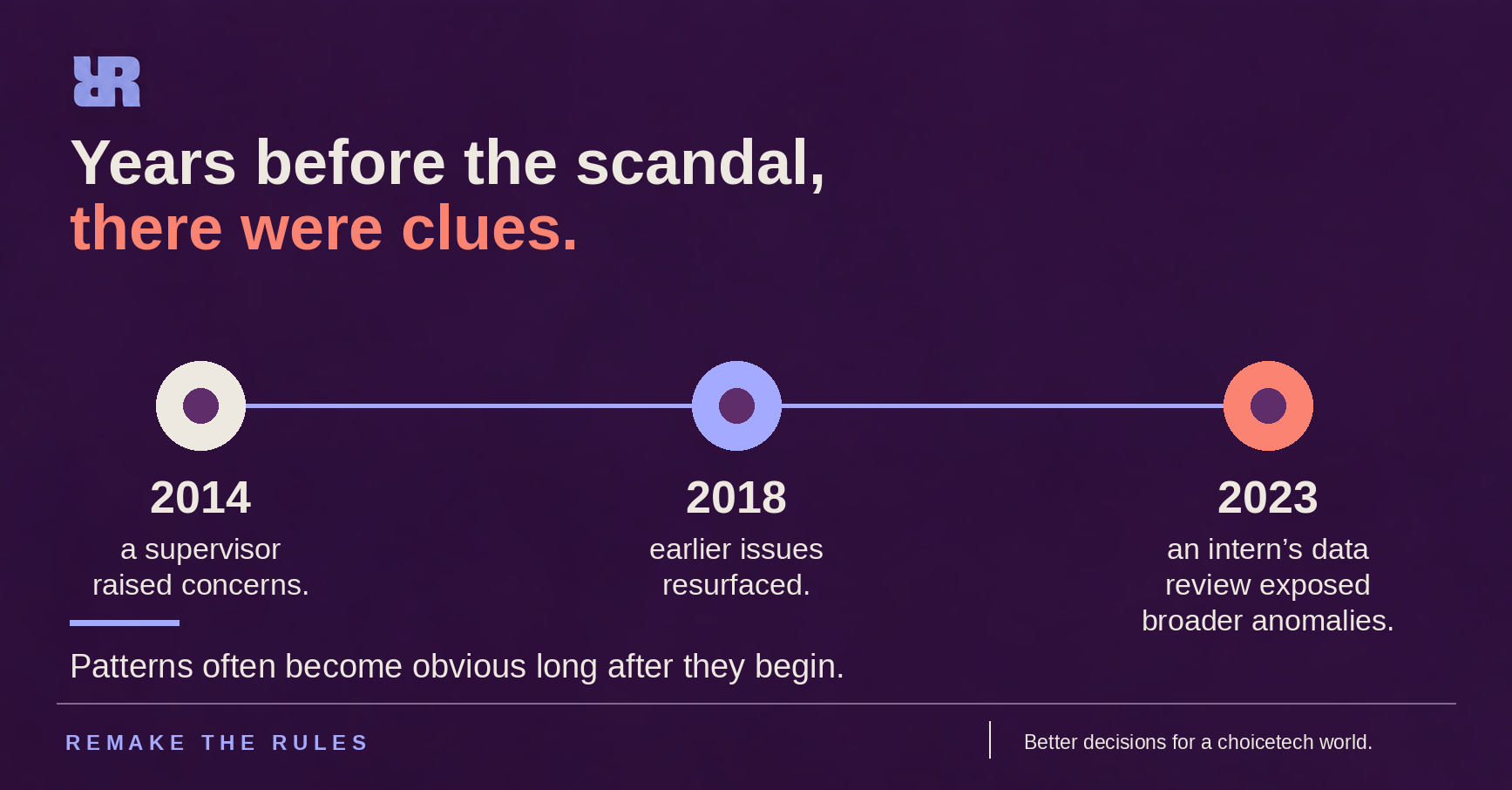
The Woods case also contains earlier points of concern. A coworker reported concerns about her testing in 2014, and in 2018 she was removed from casework while an accusation of data manipulation was reviewed, then later reinstated. Those facts do not tell us what the organization as a whole knew or what conclusion should have been reached at either point, but they do show how concern can exist in pieces long before it becomes legible as a pattern.
Extensive documentation can coexist with a poor understanding of how a process is actually behaving. A perfectly recorded event may never be examined, while a concern that seems isolated to one person may be part of a pattern whose other pieces are scattered throughout the organization.
Information can fail to inform. Even when it reaches someone, it may never acquire enough meaning or weight to change what happens next.
Designing for Reliable Judgment
Consequential institutions contain thousands of decisions that no leader could personally make or review. Leaders can, however, shape the environment in which those decisions happen.
I think of this as the institutional decision environment: the information, processes, measures, technology, incentives, authority, and professional norms that shape how decisions get made throughout an organization.
A good decision environment makes sound judgment more repeatable, especially when the right answer varies and relies on in-the-moment judgments. In consequential work, discretion is often the point.
This is the problem high reliability design is meant to address: how to make consequential work more dependable without pretending the people, conditions, or decisions involved will ever be perfect or perfectly predictable.
Qualified people and written procedures can only take us so far. People work with incomplete information, technology fails, policies meet unanticipated circumstances, and workarounds emerge in response. And sometimes, people make choices they know they should not.
A good decision environment has to function under those conditions. Its structure should support sound judgment in the ordinary course of work, while preserving meaningful exceptions and making emerging patterns available for early evaluation.
Something looks different. Why? And what does that mean?
An outlier may be exercising the best judgment in the room. Careful work can look inefficient when the expectation itself is unrealistic, and an important safeguard can resemble unnecessary delay inside a badly designed process.
Variation gives the organization a way to learn how its decision environment is actually functioning, including where it may be supporting good judgment and where it may be creating unnecessary risk. Variation is useful because it gives the organization something to learn from, not because every difference needs to be corrected.
Using What the Organization Knows
Most work now leaves a digital trail. Records change, cases move between people, and systems accumulate timestamps, overrides, exceptions, keystrokes, and other traces of how the work actually unfolded.
Software can flatten the complexity of reality into fields and statuses. Yet the same systems can reveal patterns that would once have been scattered across paper files and individual memory.
That is close to what happened in the Missy Woods case. In 2023, a CBI intern discovered missing DNA data in a sample Woods had processed in 2018. A broader review found similar alterations and deletions, prompting the deeper investigation. The underlying records themselves contained traces: altered quantities, undocumented retesting, and multiple versions of testing.
An unusual turnaround time or a recurring override tells us very little by itself. The explanation could lie with the employee, the work, the process, or the expectation against which it is being judged.
What the pattern gives us is a place to start asking better questions about how the work is actually happening and whether the surrounding conditions are helping it go well.
More information only helps when the organization has a way to make sense of it. That means putting it in front of people who have enough context and expertise to interpret it and enough authority to ask what should happen next.
An unusual pattern may turn out to be entirely reasonable. It may instead expose a process that no longer works, a training problem, an unrealistic expectation, or a serious risk. The organization needs the tools and processes to find out.
Accountability should follow the same logic. Responsibility may rest with the person who made a decision, but it can also extend elsewhere: to a supervisor who had access to a recurring pattern, leadership that created a problematic expectation, or a process that made an important safeguard too easy to bypass. More than one of those can be true at the same time and to different degrees.
I think of this as well-placed and proportionate accountability.
Hindsight Is Not Enough
Judge Andrew Poland put it plainly at sentencing: “At its core, this case is about trust.”
By the time hindsight gives us a clean story about what went wrong, the people affected have already lived the consequences. The institution has already been degraded. The trust is gone.
No system can guarantee that nothing will go wrong. People can circumvent safeguards, institutions can misread information, and the tools we build to help can introduce problems of their own. What we can do is design institutions that are better able to avoid preventable failures and respond intelligently when issues do arise.
That requires more than having the information. It requires a decision environment that supports sound judgment from the beginning, while giving the institution a better chance of recognizing and responding to problems that still emerge.
—