

Choicetech literacy:
the knowledge and judgment needed to make better decisions within the complex, data-rich environments shaped by technology.
Remake The Rules provides comprehensive services to support better decision-making within information-rich environments.
What Is Choicetech Literacy?
Choicetech literacy is the knowledge and judgment needed to make better decisions within the complex, data-rich environments shaped by technology.
I use choicetech to describe the extraordinary digital information tools now woven throughout our lives: search engines, dashboards, dating apps, hiring platforms, recommendation systems, AI tools, metrics, rankings, maps, workflows, and countless other technologies that shape what becomes visible, comparable, measurable, selectable, or actionable.
These tools have dramatically expanded what we can know, compare, generate, analyze, and choose. But our choicetech has far outpaced our ability to decide well with it.
That is why I teach choicetech literacy.
What choicetech literacy teaches.
I teach choicetech literacy through three paired ideas.
The first half of each pair helps us understand something important about modern decision environments. The second gives us a way to navigate it.
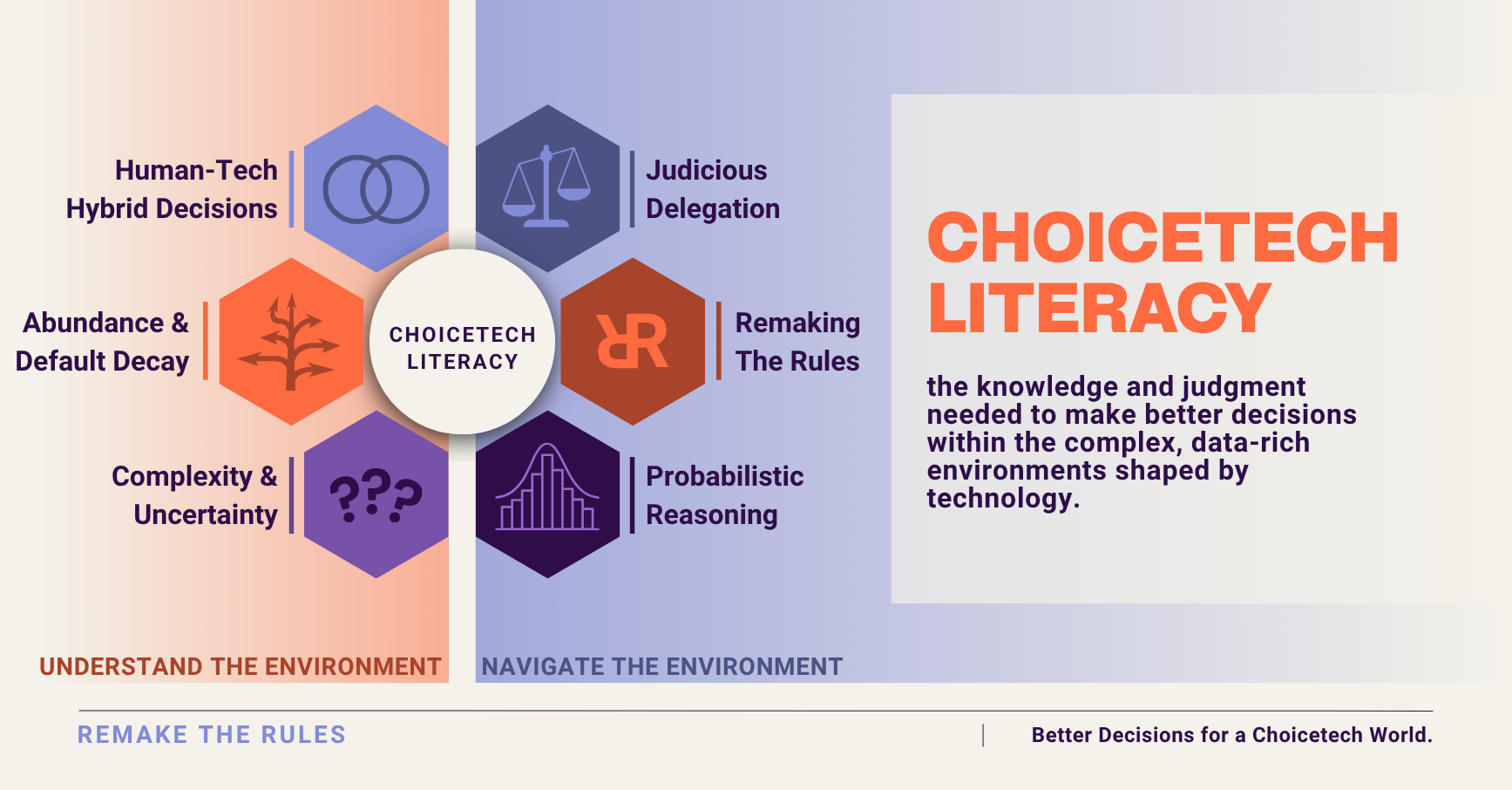
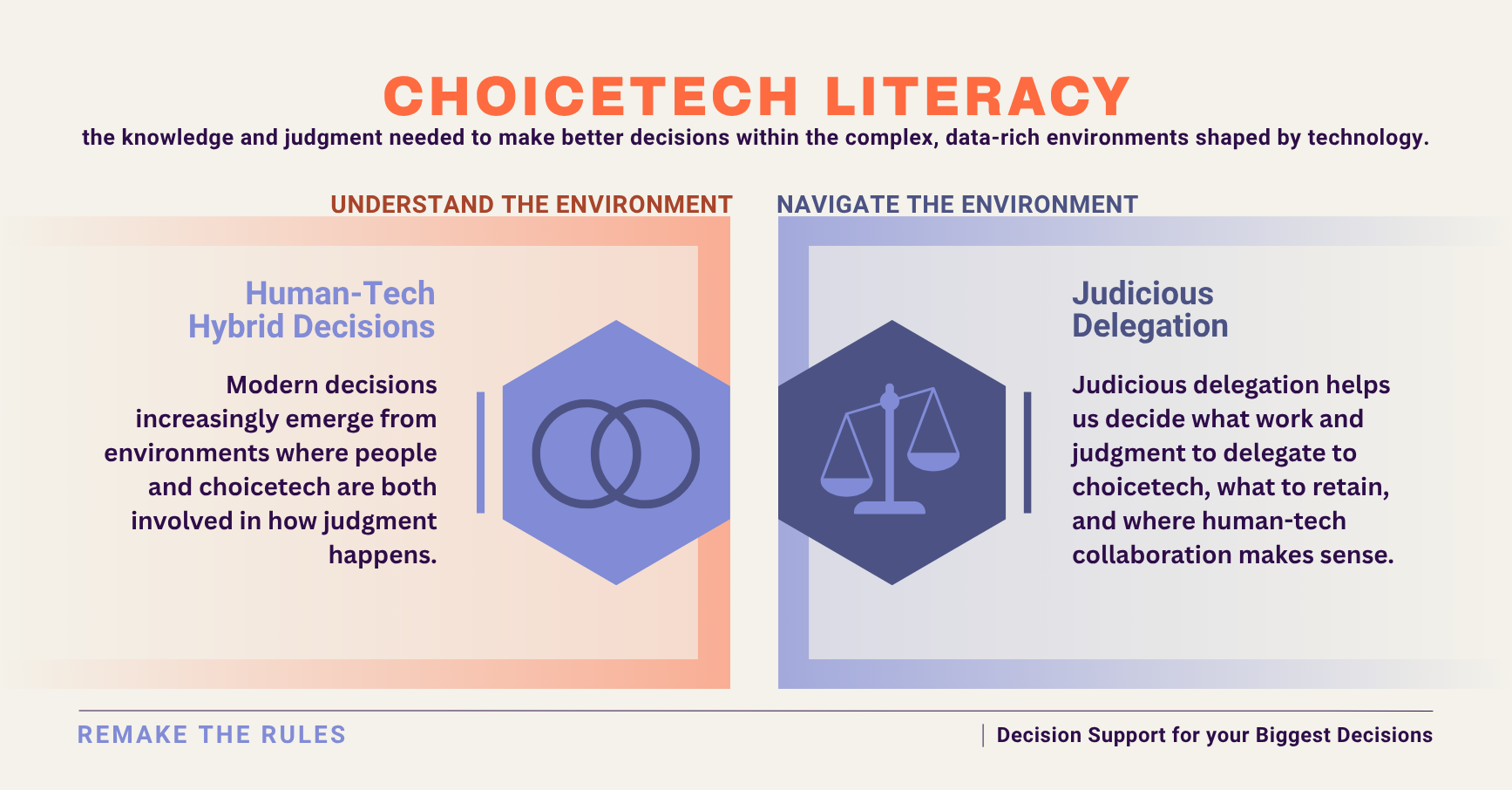
Human-Tech Hybrid Decisions + Judicious Delegation
Modern decisions increasingly emerge from environments where people and choicetech are both involved in how judgment happens, in other words, our choices are human-tech hybrid decisions.
Judicious delegation helps us decide what work and judgment to give to choicetech, what to retain, and where human-tech collaboration makes sense.
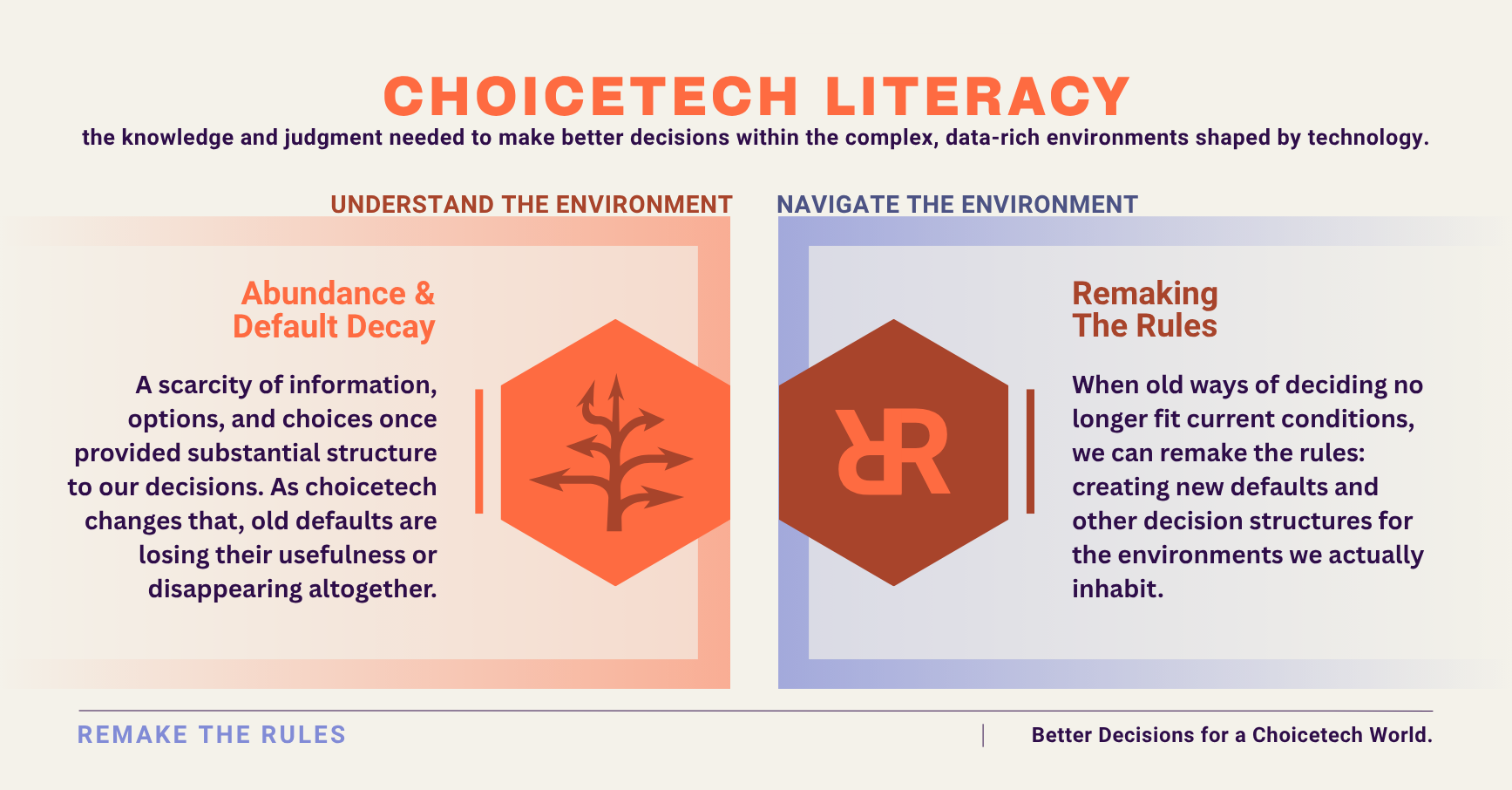
Abundance & Default Decay + Remaking the Rules
Choicetech expands what we can know, consider, compare, customize, and reconsider. That abundance and can weaken defaults that were built for more constrained decision environments, creating choice inflation.
When old ways of deciding stop fitting current conditions, we can start remaking the rules, building new defaults and decision structures for the environments we actually inhabit.
Complexity & Uncertainty + Probabilistic Reasoning
More information and analytical power can improve our decisions without making complexity and uncertainty disappear.
Probabilistic reasoning helps us think in likelihoods, variation, evidence strength, and degrees of confidence so we can make good decisions without requiring certainty or simplicity.
Better Decisions for a Choicetech World
The tools will keep changing. The need to decide well within the environments they create will not.
That is the purpose of choicetech literacy and my work at Remake The Rules.
Let’s get to work.
Explore how Remake The Rules helps leaders build resilient institutions.
Learn how Remake The Rules brings comprehensive support to your most pressing and complex choices.
See how Remake The Rules puts you back in charge of your choicetech and your decisions.