Why Swiping Less Isn’t Enough
“Just swipe less.”
It’s become one of the most common pieces of advice in modern dating, usually delivered with a knowing sigh, as if the problem with online dating is simply too much.
And sure, there’s truth in the idea that endless swiping can lead to burnout, numbness, and decision fatigue. But reducing dating to a question of volume—more or less—misses the real issue entirely.
The deeper problem is the mismatch between effort and payoff. Too much frustration. Too much exposure to what you don’t want and almost none of what you do want.
Because swiping less doesn’t actually fix the problem.
It just shrinks the environment. It's just less, not necessarily better.
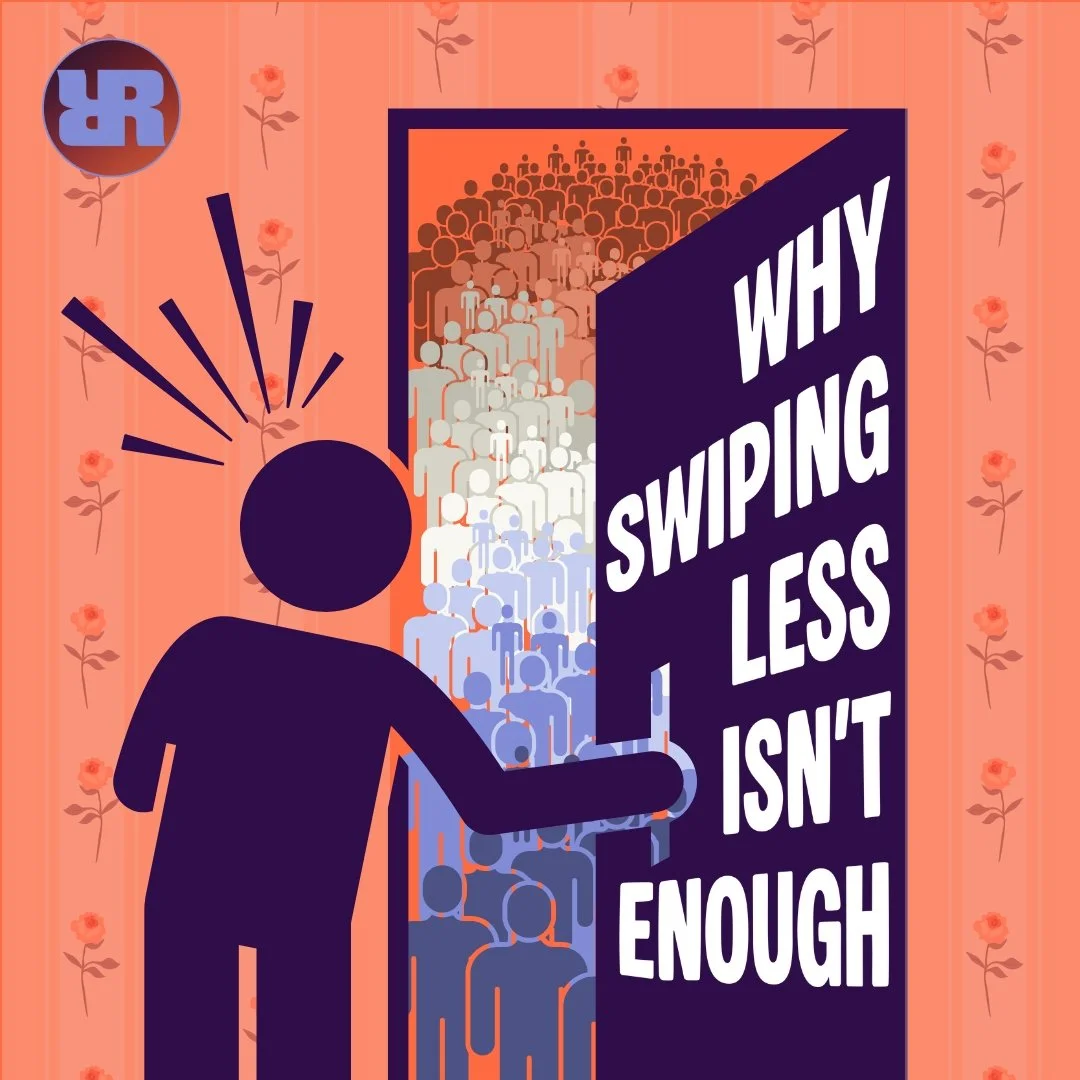
Shrinking the Problem Isn’t the Same as Solving It
When people abandon dating apps they often frame it as reclaiming something more “natural,” more human, more grounded in real life. As if opting out of the apps automatically restores a healthier dating experience.
But what usually happens instead is this:
You return to a smaller pool of people.
You rely more heavily on proximity, chance encounters, and social overlap.
And you still face the same core challenge—figuring out who you’re compatible with—just with fewer options.
In other words, you haven’t escaped the complexity of dating. You’ve just reduced your exposure to it.
Before dating apps, most people met partners through work, school, friends, religious institutions, or shared community spaces. Those environments felt simpler, but they were also highly constrained, by geography, class, race, culture, schedules, and social norms. Access was limited, even if it didn’t feel that way at the time.
Online dating, and the internet in general, exploded those constraints. Suddenly, you weren’t just encountering who happened to be nearby but the whole world. That expansion brought enormous potential… and a lot of discomfort.
The Real Issue Is Variation, Not Volume
What people often experience as “wrong with the apps” is actually too much variation.
Online dating exposes you to people with different communication styles, values, timelines, relationship goals, emotional availability, and cultural backgrounds, often all at once. That diversity can be powerful, but only if you know how to work with it.
Without skills for navigating variation, your nervous system goes into defense mode. You start filtering aggressively. You swipe based on surface-level cues. You disengage faster. You default to heuristics like “spark,” “vibes,” or “I’ll just know.”
Swiping less or more mindlessly doesn’t address any of that.
It just limits how often you have to confront difference.
And here’s the uncomfortable truth: even if you quit dating apps entirely, variation doesn’t go away. If anything, it’s increasing everywhere. Offline dating isn’t a simpler version of the problem. It’s the same problem just smaller.
You’re Already Managing Variation, Whether You Realize It or Not
Both online and offline dating require the same fundamental work:
Deciding what kinds of people you want more exposure to
Deciding what kinds of dynamics don’t work for you
Learning how to recognize compatibility early, without certainty
Making peace with ambiguity, tradeoffs, and imperfect information
In real life, you manage this through routines, social circles, repeated environments, and subtle pattern recognition. Online, you manage it through profiles, filters, messaging, and algorithms.
Neither environment eliminates the need for discernment. They just structure it differently.
When people say they’re “better at dating in real life,” what they often mean is that the constraints are doing more of the work for them. The pool is smaller. The social scripts feel more readily available. The stakes feel more familiar.
But that doesn’t mean it leads to better outcomes.
Dating Apps Are Not the Enemy—Unskilled Use Is
The tragedy of the “just swipe less” narrative is that it encourages people to abandon tools with enormous potential instead of learning how to collaborate with them.
Dating apps aren’t just marketplaces. They’re choice technologies, choicetech, systems that shape what you see, how you interpret it, and how you act on it. Like any powerful tool, they amplify whatever skills (or gaps) you bring into the environment.
If you don’t know how to:
set meaningful constraints,
interpret signals without over- or under-weighting them,
pace yourself sustainably,
or integrate online interactions with real-world decision-making,
then yes—dating apps will feel overwhelming, dehumanizing, and exhausting.
But the solution doesn't have to be opting out entirely. The solution is to develop the capacity to use them well.
Why Not Both?
Instead of framing dating as online versus offline, a more realistic question is:
How do you want to distribute your effort across different environments?
Online dating offers breadth, intentionality, and access beyond your immediate world.
Offline dating offers context, embodiment, and slower signal accumulation.
They solve for different constraints; and when used together, they can actually reduce pressure rather than increase it.
But that only works if you stop treating dating apps as slot machines or shopping catalogs and start treating them as collaborative systems that require skill, reflection, and realignment.
The Work Isn’t Swiping Less. It’s Choosing Better.
Modern dating isn’t hard because there are too many options.
It’s hard because we were never taught how to make decisions inside environments with this much information, variation, and feedback.
Swiping less is a coping mechanism.
Learning how to date inside ChoiceTech is a skill.
And skills, not avoidance, are what allow people to access the real benefits of modern dating without burning out in the process.
If This Resonates
If this essay put language to something you’ve been feeling—frustration, exhaustion, or the sense that you’re putting in far more effort than you’re getting back—it’s not a personal failure. It’s a skill gap, shaped by tools most of us were never taught how to use well.
That’s the work of Remake The Rules.
I help people build the capacity to make better decisions inside modern ChoiceTech—dating apps included—so the tools stop running the show and start working with you.
If you’re curious about what that could look like, here are a few low-pressure ways to explore further:
Read more essays on dating, decision-making, and ChoiceTech at Remake The Rules, where I break down why modern choices feel so hard—and how to make them more workable.
Work with me one-on-one if you want support recalibrating your dating approach, refining your goals, or learning how to collaborate more effectively with the apps you’re already using.
Join the Remake The Rules newsletter for thoughtful, non-performative reflections on modern life, love, and decision-making—delivered without hacks, shame, or false promises.
You don’t need to swipe less. You don’t need to opt out.
You just need better tools, better strategies, and permission to remake the rules you’re playing by.